Monday, June 5, 2017

Media & Computing Studio

It seems fitting that I am finally getting to the last of the four studios, Media & Computing, as the year wraps up.  The Media & Computing Studio is the perfect flexible space for robotics, programming, film making and recording.

Just like our other studios, furniture is completely mobile.  Many times, the tables are folded up and pushed out of the way to provide an empty floor for robot racing or Lego building.
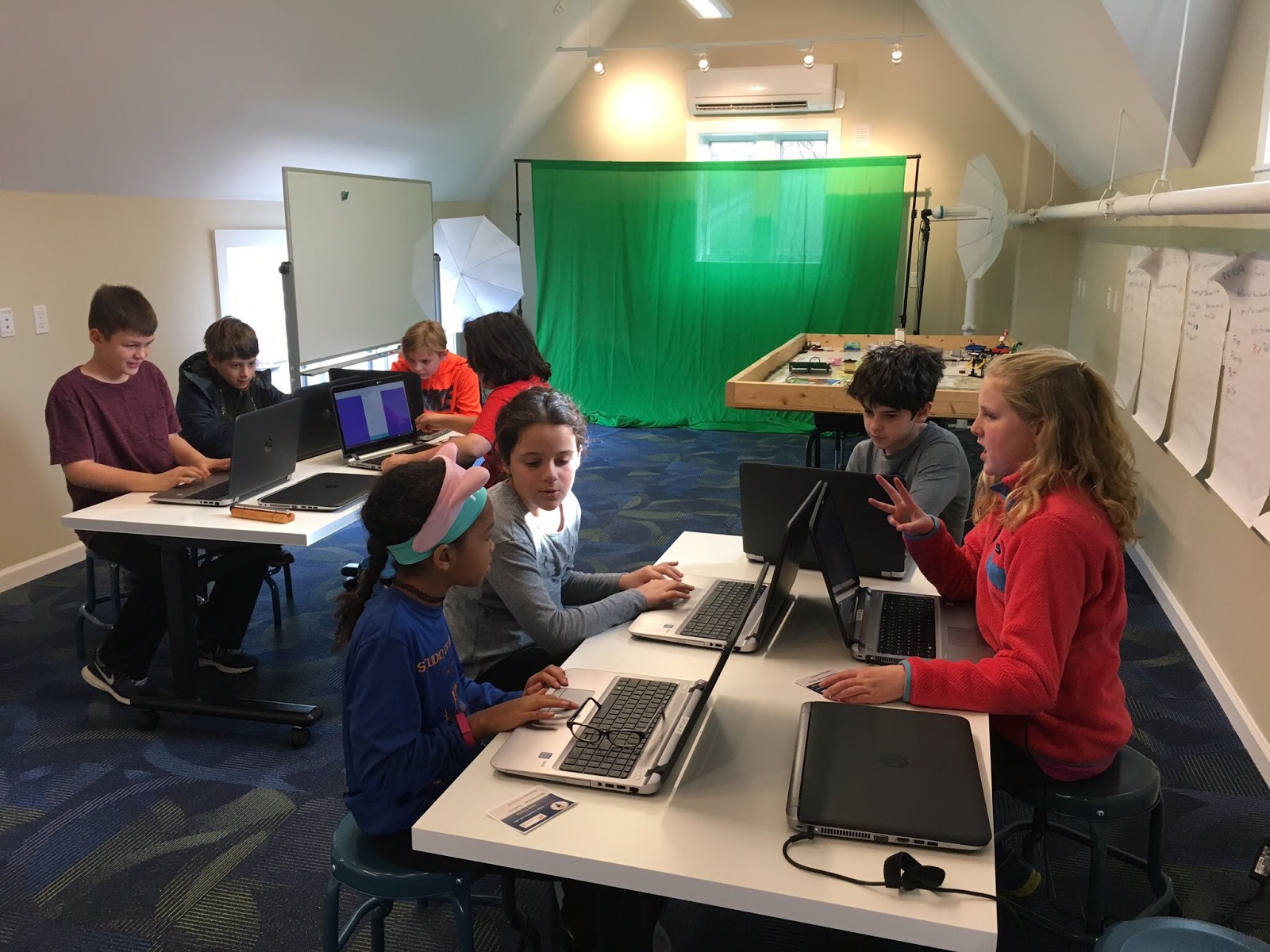


It is the only room with wall to wall carpeting to help control sound levels.  The windows have black out shades to help keep light levels even behind the portable green screen.  Wire racks house the library of robots and electronics, including BlueBots, Dash and Dot pairs, Lego Mindstorm EV3s, and Makey Makey Inventor's kits.


The green screen has been used by a variety of grades to film class movies, make commercials, and provide a digital option for open-ended projects. Most recently, Pre-KB completed their Road Trip Video  in front of the green screen with their homemade wearable cars.  So much fun!


Every teacher knows the value- and rarity- of a quiet space when trying to record student's voices or music.  The Media & Computing Studio even has a small soundproof Recording Room tucked in the corner.

Fifth graders used this space early this year to record their Kindergarten buddies' rainforest fun facts to use in their Scratch programs.  Second graders took turns recording voice-over for their cell animations in iMovie.   

Perhaps next year we will use this space for instruments and music composition.


The Media & Computing Studio wouldn't be complete without a class set of devices for programming and design.  The laptop cart lives in this room, but devices can be pulled at any time for use through the Light Lab.  

Our LS students are one-to-one with iPads in their classrooms so those frequently travel with kids over to the Light Lab. It's great to have choices so we can use the technology that best suits our needs for any project.


Our First Lego League team holds their Robotics Club in fall and winter in this space so the competition table is another addition to the room.  Each year, the board will get updated to reflect the new challenges.  Students use their iPads to program using the drag and drop LEGO Mindstorm platform.

Currently, third graders are getting their first exposure to EV3 robots during Science with Ms. B.  They are learning the basics of movement commands: how to control power, speed, direction, and duration.  Through a series of challenges, they use trial and error to move their bot around a course to avoid obstacles.


Coding Club has been using the space since the opening with Ms. Kirk exploring all our new bots and a variety of coding apps.  These kids have learned more than just the basics of coding for Dash and Dot as well as Scratch.  

Even the hallway outside the Media & Computing Studio is getting some use with our bots!


Ms. Kirk, Ms. B and I are really excited about the possibilities next year brings in expanding the programming and robotics curriculum for all our Lower School kids.  We will continue creating more opportunities at FCS for all age groups to explore the new literacy of coding.


Tuesday, May 9, 2017

Design Studio

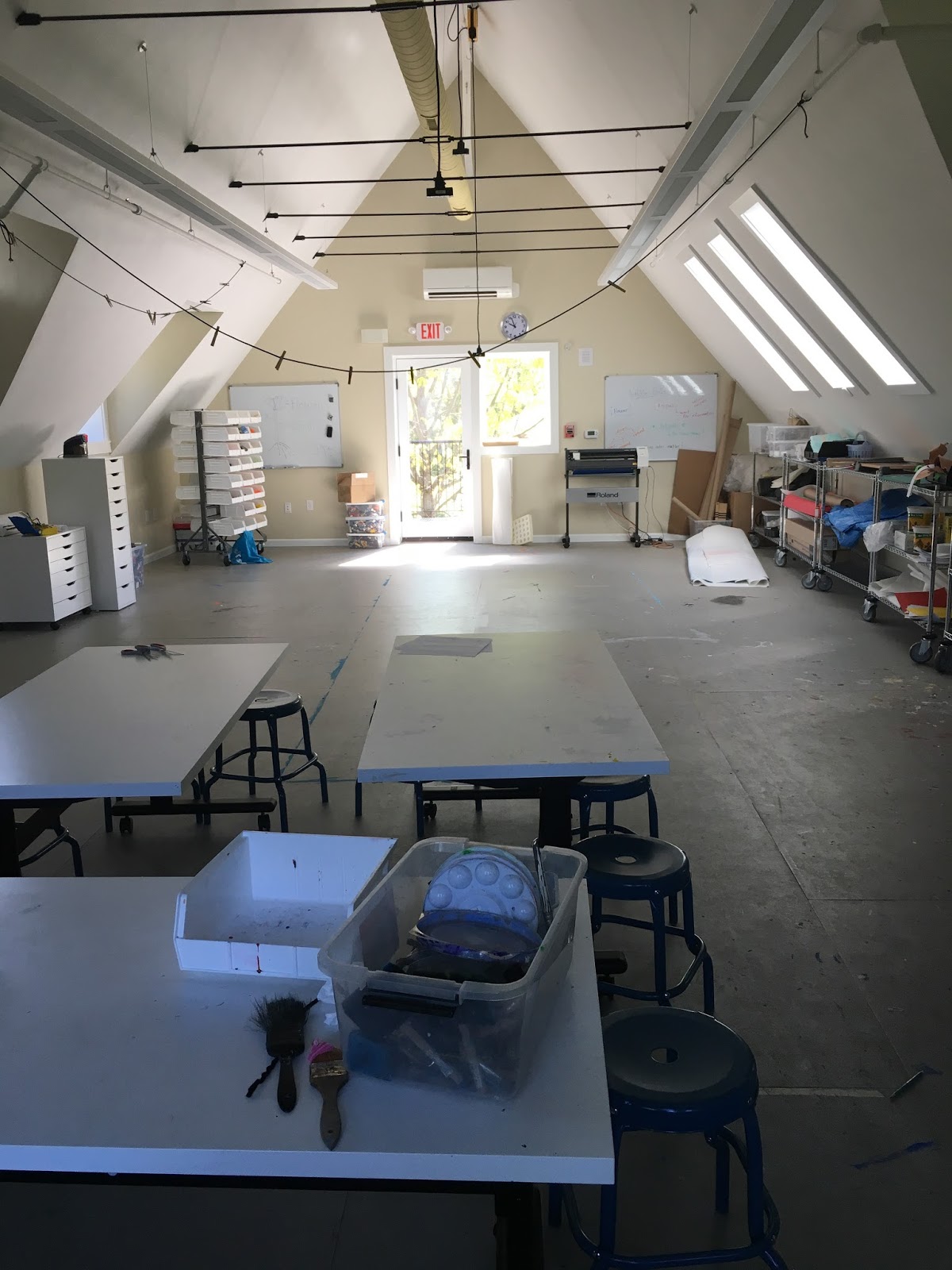
The Design Studio is the most flexible space in the Light Lab.  With beautiful sky lights and full access to a large balcony, this studio welcomes designers to use natural light and outdoor views for inspiration.

The floor was specifically left unfinished with painted plywood so it would encourage happy messes while kids create.  The flooring can also be directly drilled into in the case that we build something large that needs anchoring. It can easily be repainted or repaired each summer.


One full wall of mobile wire shelves is generously stocked with art supplies, recyclables for building, all types of paper, modeling clay, air-dry clay, model magic, popsicles sticks, stamps, pastels and fun design embellishments.


Although most of the higher tech equipment is kept in the Fabrication Studio or the Media/Computing Studio, this room has two vinyl cutters and a full LittleBits electronics library for prototyping and inventing.  Our Pre-K students used electronics earlier this year for their rockets and wearable cars.  Fourth and fifth graders had full access to the LittleBits during their State Fair Projects and If the World Were a Village Projects.

The Design Studio provides a perfect spot for large-format art; when the tables are folded and moved to the side, the vast open floor space allows classes to make scenery for a play or life-size models without taking precious classroom area.  Clothing lines give teachers the opportunity to hang projects that need time to dry, like paper mache globes from KB or Native American clothes made by 3B.


Ms. B has used the space frequently in Science this year for an impressive range of creative projects which demonstrate deep scientific learning.

Second graders designed animal or plant cell models with clay and used those models to animate the function of several organelles.  After importing the animations into iMovie, pairs recorded narration of what was happening.


Third grade scientists used their unit on human body systems as an opportunity to make life-size models of their own bodies complete with a skeletal, muscular, and respiratory system added in separate layers.


On most days, students are using the art supplies in this space to embellish and beautify their creations.  Paint supplies may travel from this space to any of the other studios depending on what other building materials or tools they may need.

The balcony gives us the perfect space and height to conduct some scientific experiments.  Fourth grade had an epic egg drop earlier this year.  Paper Engineering Club laughed and cheered when sending their parachutes and airplanes over the edge.


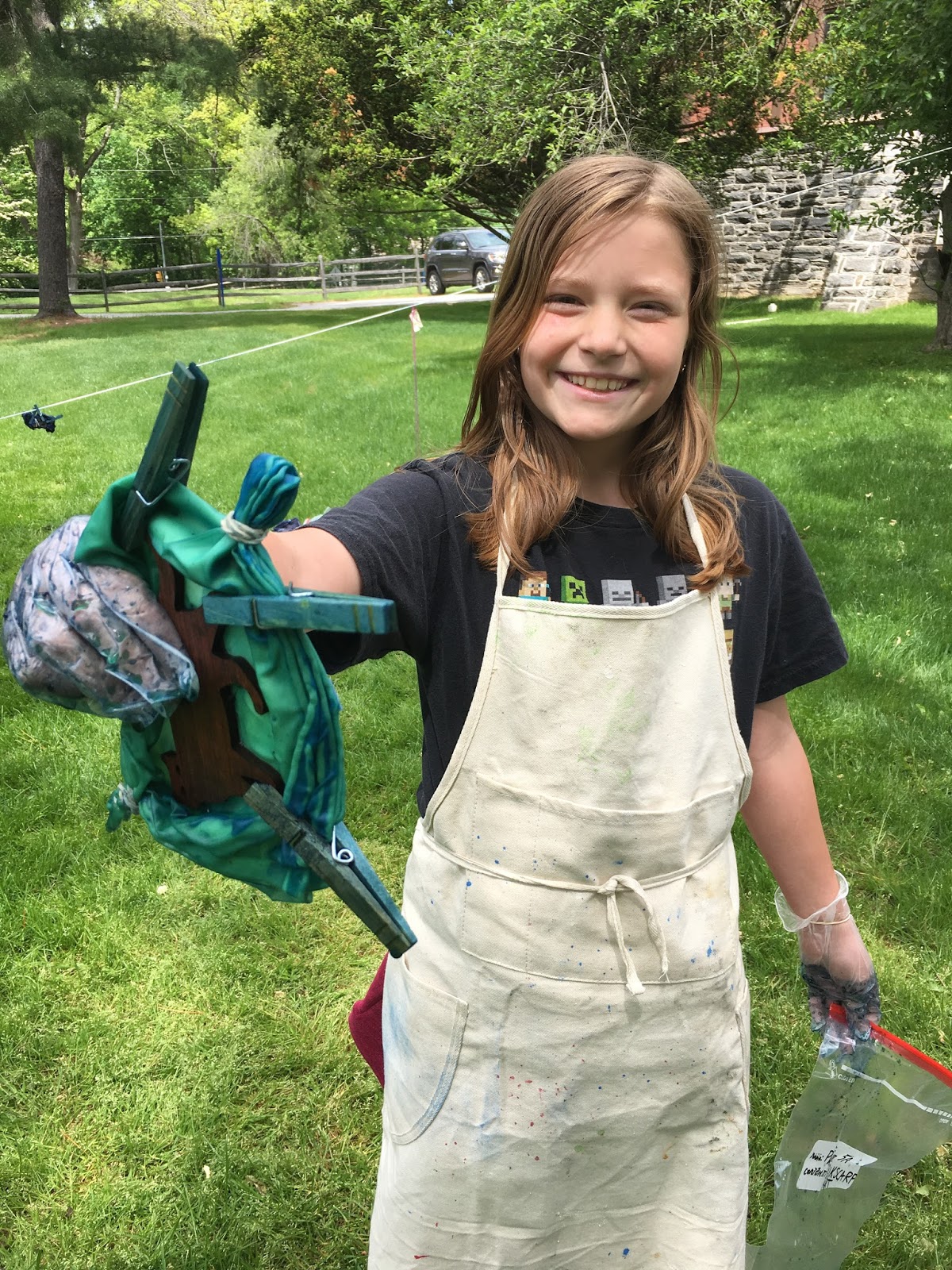
Currently, Ms. Parris is helping fifth graders explore Shibori dyeing techniques with the use of custom designed laser cut wooden shapes.  The shapes will be folded inside silk scarves and dipped in indigo dye.


 Ms. Parris even used the outdoor space behind the Light Lab, hanging drying lines between the tall trees.  We are all excited to see the beautiful results of this fun project!

Wednesday, April 12, 2017

Natural Sciences Studio & Solarium

As promised, I want to give readers the opportunity to learn more about the individual studios in the Light Lab.  This post focuses on the Natural Sciences Studio and the attached Solarium.


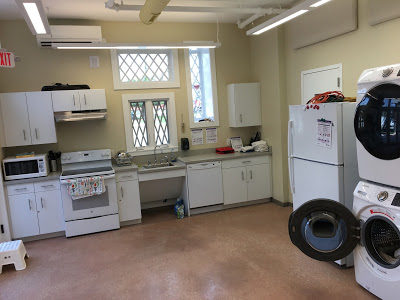
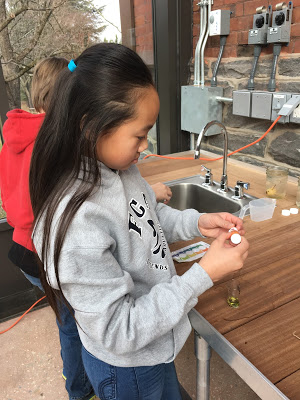
The Natural Sciences Studio is outfitted with a full kitchen, washer/dryer, basin sinks, beautiful concrete floors and one of our two truth windows.  The Solarium can be accessed directly from the NS Studio and so both spaces are frequently used together.


This studio feels very unique to the Ulmer Family Light Lab.  I've visited my share of makerspaces equipped for all age ranges; I have yet to see a space that has so fully embraced the valuable learning that happens in a kitchen or greenhouse.


Maker Ed curricula sometimes focuses heavily on the higher tech materials like robotics, programming, and expensive fabrication tools.  While fun - and certainly important tools to have in your makerspace - laser cutters, 3D printers, and programmable robots really aren't any more valuable than a big set of measuring cups, mixing bowls, and a well stocked pantry.  Experimenting with food feels approachable to nearly everyone while adding authentic opportunities to explore rich math concepts like measurement and fractions.


Growing and cooking together provides students and teachers with a chance to connect on a highly personal level.  Research continues to point toward the importance of shared family meals. I would argue that I've witnessed those same benefits between school community members who regularly have the opportunity to prepare and enjoy a meal resulting from their combined efforts.


Take a look at a sample of the delicious projects that have taken place this year:


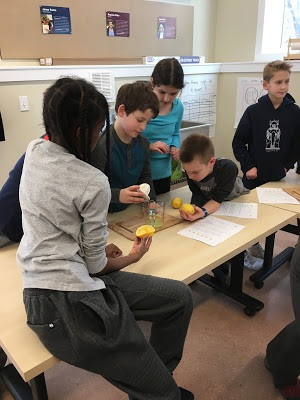
Fourth Grade grew lemons in their room.  When the time came, they juiced and made homemade lemonade to share in the Solarium while they listened to a favorite story.


In a first grade reading group, friends loved when a character made strawberry shortcake in a special story so their teachers decided to visit the Natural Sciences Studio to make shortcake together as an extension. Our huge basin sinks made it easy to get everyone involved in the clean up, too!


Kindergarten learned about Passover while making special candies with their teachers.


Third Grade made yummy Brazilian chocolates before Winter Break. Recently they visited to make a some traditional Native American foods.


Middle schoolers spent an entire week before Spring Break exploring cooking with Ms. Mutchnick. Pictures are coming soon.


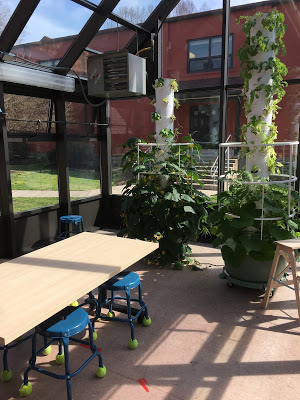
If you've not yet visited the Solarium, I encourage you to come when you need a few moments of peace.  The beautiful aeroponic towers are bursting with squash and cucumber blossoms, crisp kale leaves, fragrant basil and tender salad greens.  When the pumps turn on, water rains down inside the towers sending nutrients to the roots growing inside. The Solarium is filled with the sound of gentle rain.  


It's magical.


Fifth graders have been visiting twice weekly to take the pH of each tower and to harvest as needed.  Plants seem to come to harvest twice as fast in our towers as compared to outdoors.  The results continue to surprise us although they really should not; our lucky plants are getting an optimal amount of nutrients, sunlight and a consistent temperature.


Chef Wadiya and Chef Maggie use our harvested veggies to feed fifth grade as well as our other students and teachers at lunch.  It is amazing what our kids will try when they have personally cared for the plants and harvested!  We had some friendly debates on which salad greens are the best. Swiss chard, kale, speckled lettuce or spinach?


What do you do when you don't have bees to pollinate?  Your students get to "tickle" the blossoms with q-tips, doing the important work of our missing insects.  Nursery is looking forward to visiting later in April to germinate beans, dissect a swollen bean, and serve as our pollinators for the day.   


Stay tuned for some time-lapse videos taken in the Solarium.

Friday, February 24, 2017

The Fabrication Studio

As our makerspaces come together, I intend to dedicate a blog post to each of our four unique studios.  This post will focus on the Fabrication Studio which has quickly become my "home" in the Light Lab.

With a clear view to the courtyard through the beautiful glass doors, I can get ordering, scheduling, and anything digital accomplished while keeping my eye out for visiting students and teachers.  I've put the most hours in the organization of this room so far and it is beginning to really show.

This studio includes many unique features that help it work well for our students:
  • Pull-down electric cords - particularly useful for tools and glue guns.
  • Concrete floors for easy clean up
  • Glass panelled closet to store noisy 3D printers when needed
  • DIY sound panels
  • Whiteboard table tops that flip up to allow work space to become presentation space
  • Dynamic furniture that is flexible, moveable, serves multiple purposes
  • Double doors for transporting large materials in and out
  • Large basin sink

The Fabrication Studio

Large basin sink, cardboard storage and the laser cutter in the corner

Sewing Station

3D printers, Bulk Fabric and Plenty of Tools

Neat & Functional

From the start, I knew Fabrication would be where I would spend the majority of my non-teaching time.  It houses the most equipment of any studio with the laser cutter, 3D printers, sewing machines and woodworking tools.  This range and versatility make it feel like a place where nearly anything could be made and hopefully will be as time progresses.

Since November, our students have used it to:

  • Construct wooden covered wagons
  • Sew costumes for a play
  • Create an interactive bulletin board
  • 3D design and print Roman coins
  • Build cardboard prototype castles using design thinking
  • Make light-up paper circuit Valentine's Day cards
Fourth graders are currently working on individualized state projects that may incorporate laser cutting, 3D design or construction.  Fifth graders became so enthralled with their study of our solar system in science, they asked to create solar system models.  Their design plans and material lists are finished.  Each group is beginning to construct this week.

Next up, the Natural Sciences Studio.

Thursday, January 12, 2017

Welcome 2017

Welcome January - my absolute favorite teaching month of the year!

The Light Lab was full of a wide variety of students and teachers in December, making the weeks before the winter break just fly.  In my 13 years of teaching, I have always felt that I'm running a race from September to the end of the calendar year.  From Back-to-School events to Halloween to Thanksgiving to the various End-of-the-Year Holidays, I crave the winter break to regroup.

I look forward to January when I can return to students who are already settled into their classes with a quiet month fairly void of distractions from teaching.  It's really the heart of the school year.  I always feel like so much gets accomplished in this long month.  This year won't be an exception!

Our young ones are in the Light Lab in full force this month with both Pre-Kindergarten classes taking on exciting projects.  Pre-K B continues to make progress on their wearable cars.

They added spinning wheels to the car base today with great success.  We're going to problem solve a little together to make the wheels more stable when they are sitting on the floor.  The brads allow great spinning but are hard to secure without impeding their movement.


Our second task taught us about electricity and how to build a simple Little Bits circuit as a car horn.  They did an amazing job with this part!  Not a single student wasn't completely engaged and delighted by their working horn.


They couldn't wait to start thinking about where to place the horn inside their car.  We'll work on installing the circuit onto the car wheel with velcro next week.  Our Little Bits circuits were conveniently secured with little velcro feet so we can easily do this next step.


Pre-K A begins to build rockets this week as they continue studying space.  Each student made the body, cone, and fins of their rocket.  They will add flaming cellophane and lights next week.  I'll post pictures soon.

KB has been learning about the layers of the Rainforest.  Kindergarteners used the Fabrication Studio today to start their interactive rainforest board.  They are working on creatively making the background illustrating the four layers with trees, clouds, leaves, vines, greenery, flowers and a river.  They joyfully used a wide variety of materials from twine to cellophane and fabric to pipecleaners to create their individual contributions to the community board.


As we work through the next weeks, each student will research and create a rainforest animal to add to the board.  Each animal will have a foil touch button that will activate a custom sound recording in the student's voice teaching the viewer about their animal.  Fifth grade book buddies will be working on writing the codes in Scratch and helping to record their buddy's fun facts.  They will also help us wire everything together using the Makey Makey Inventor's Kit.  

Stay tuned for more.